Showing posts with label Rosario. Show all posts

Thursday, November 15, 2012

11 Odd Things Learned in the Course of Translation


--tidbits picked up in translating Beyond the Islands (Alicia Yánez Cossío) and Trafalgar (Angélica Gorodischer)--

Some days, translation is like a treasure hunt, a sanctioned scavenge after curious words and unfamiliar allusions. (Happily, I'm a fan of dictionaries and reference books; my dictionary stand is a prized possession.) When the project's finished, some of those definitions and associations slip back out of mind and beyond memory, but others linger. These details may already have been known to many of you, but they were new to me.

Boulevard Oroño
Riddle or rest?
  1. Aerugo is another word for verdigris (a green or bluish patina formed on copper, brass, or bronze surfaces exposed to the atmosphere for long periods of time).
  2. A tero is a Southern lapwing, a loud-voiced bird common in South America. 
  3. Rosario's Oroño Boulevard is indeed lined with "cold, serious, heavy houses, with grilles but without gardens, maybe at the most a tile patio paved like the sidewalk" -- and also with palm trees, Sphinx benches, and Sunday strollers. 
  4. José de Villamil, born in New Orleans in 1788, later became an advocate for Ecuadorian independence and was the first governor of the Galápagos islands.
  5. Baby's breath is also called gypsophila.
  6. A pair of embracing skeletons, found in an 8000-year-old burial site on the Santa Elena Peninsula (Ecuador), have been called the pre-ceramic Adam and Eve or Los Amantes de Sumpa.
  7. Newell's Old Boys (one of Rosario's soccer teams--early team of Lionel Messi) can also be spelled Ñuls.
  8. Aguamala is a word for jellyfish (not nasty water).
  9. Opuntia is a prickly pear.
  10. Cheviot is a fine, wool fabric. Also a breed of sheep.
  11. And Trafalgar is not only a the name of a battle, and--in Gorodischer's stories--a proper name, but the title of a Bee Gees song.

I'm getting ready to start a new project. I wonder what I'll learn this time around?

Wednesday, December 28, 2011

Puzzling

I do two or three jigsaw puzzles a year: one in January when we go to the coast for a weekend with my parents and my brother and his family, and another one (maybe two) over winter break or during the summer. This break, I've been putting together a 1000-piece puzzle of the Mona Lisa.   

I don't usually buy "great art" puzzles--I tend more toward landscapes or, honoring my children's interests, marine life--but my husband bought several at a bookstore liquidation last summer, and my son lured me in with the siren song of parent-child collaboration. Of course, my collaborator is long gone, and the card table has been commandeered for an epic game of Talisman, so my puzzle--on its floppily recycled corrugated board--has been relegated to the family room floor, where I hunker over it obsessively, inviting paralysis, or at least a bad back. 
I enjoy the momentary triumphs (ha! the hairline is complete!), the undisciplined  hum of just-one-more-piece-and-then-I'll-quit, the time to muse. 

Spread across five or six small pieces, the famous smile is indeed enigmatic. It took a while even to identify the partial, blurry curves as lips. The puzzle also has a higher than average incidence of false positives--those pieces that definitely fit, until you realize they don't. Pieces that seem to fit for a long time, throwing the rest of the project off.

It's completely cheesy to commune with great art through a cardboard puzzle mass produced in China, sold for cheap by a failing bookstore, stored on a shelf cluttered with board games and kids' books and weird crafts sets no one will admit to having purchased or requested. But I do find myself thinking about that smile, and the blend of colors, and the expression in her eyes. And the aged, cracked paint, reproduced here as a network of tiny amber lines or smears that interweave and distort and return. Brand new and glossy in all its antique fragility--memory and stories and play-time, oh my!

What would Leonardo think? What would any of them think, the composers whose most famous concertos litter the universe of ringtones and commercial jingles, the painters sold and resold on umbrellas and coffee mugs? I imagine a dialogue or perhaps a debate (like the dreadful film we watched in AP history, with James Madison and Alexander Hamilton reanimated off marble slabs to declaim the Federalist Papers) between two much-marketed artists on the merits of this particular flavor of immortality. Is it always better to be remembered? Sitting in a café in Mendoza in November, the kids and I had worked out half a story along those lines, the composer back to life and hearing his music in the oddest places, distorted, digitized but, hey, still audible.

When I was in Rosario, one of my treats was the Sunday free showing at Cine el Cairo, a public theater that offered Argentine films to an enthusiastic, all ages crowd on Sunday afternoons. I wasn't able to go that often--weekend trips began to intervene--but one of the films I saw was Rompecabezas, a film about a woman who discovers she has a gift for jigsaw puzzles. It's what's often called a "quiet" film; I found it absorbing. None of my local acquaintances had heard of it, so I also had the pleasure of seeming to be in the know as I described it to them. The protagonist's choice at the end wasn't entirely clear, but I've kept thinking about her, and the way the patient organization of fragmented images--the puzzle-building process--was reflected in the structure of the film. 

The movements of her hands, the way she surveyed the jumble of pieces as she began a puzzle and then arranged and understood them, also seems an apt representation of the way one might organize a story. In particular, I like the tactile sense of those pieces--weighed, removed, shifted, stacked. The way a story might be built, as if with lumber or stone. Or bits of cardboard.

Thursday, September 29, 2011

Birdwatching for Translators

I was asked recently when on this trip I had particularly felt I was somewhere else. Well, running, last Friday.

It was a gray, cold, drizzly morning with a strong wind, easily run-in-a-fleece weather; a day worthy of Michigan at the end of March (remember, we just celebrated the first day of spring). The wind was stronger by the river, and stronger yet as I turned back and realized I had had it behind me; the rain stung my face and my ears. The river looked brown, as usual, but high and choppy.

Then I saw a tero. Two, actually. I recognized them by appearance, not by name (those who know me can testify I'm no ornithologist), and I recognized their appearance because I'd been looking at photographs.

When I first read the sentence in the book I'm translating --he looked like a tero-- I had no idea. It could have been anything: a kind of rodent, a local bogeyman, an aristocratic dandy. It took some dictionary rummaging, a trail from a more local name to a more general name to a comparison of photographs to settle on the English. Tero to Teruteru to Southern Lapwing.

It was bumpy ground, rough grass and not-quite-park just where the construction site started. The two men I usually see practicing Tai Chi (always on the danger side of the keep-back sign meant to protect the unwary from the eroding bluffs) were posed in the distance. I was pulling my cold hands further into my sleeves when the dark, trailing crest at the back of a bird's head caught my eye. And I thought, I really am somewhere else now. 

[photo via Wikipedia]
Does it help the translation? Change it?  

It did push me toward using the local name, not the English name of the bird. Wikipedia will tell you about the Tero in Spanish or the Southern Lapwing in English. Lapwing now seems too domesticating (and, perhaps contradictorily, needlessly distancing; the reader who doesn't know her birds won't know a southern lapwing from a cedar waxwing). Also, to me, lapwing sounds somehow more fluid in its movements, not poking and jumping on the ground like the birds I saw, longish-legged and knobby-kneed, like miniature heron relations. But will the reader know a tero is a bird if I don't add other pointers?

It's still a work-in-progress. For now, I've got both names in the draft.

Monday, September 19, 2011

First Day of Spring

Podrán cortar todas las flores pero no acabarán con la primavera
--they can cut all the flowers but they won't do away with spring--

Lapachos in bloom
I wonder how long I'd have to live in the southern hemisphere for September to mean springtime to me. I do associate September with beginnings-- new school year, time for plans, goals, agendas, new projects. But there's also a sense of the year winding down, the days getting shorter, rain on the horizon and then in your shoes.

But here in Rosario, people are gearing up for spring. The last of the winter merchandise is heavily marked down. Changes in the bus schedule are announced. It seems the first day of spring is also a day off of school-- and, according to this morning's paper, the September 21 date is also a mistake, an inexact transfer by immigrants from the northern hemisphere, so that the spring equinox they were accustomed to (March 21) was transposed to September. What went wrong? The equinox is actually on the 22nd or 23rd in this hemisphere, varying slightly year to year.   

Seasons don't arrive on schedule anyway, whatever the calendar says, or ought to say. The weather has been cooperatively variable (read spring-like, in my seasonal experience): sunny but not too hot; then a full day of warmish, muggy rain; then cold, dusty wind under a gray sky, days I've worn sunglasses as safety goggles to protect against dust instead of glare. The grass in the parks looks worn, almost threadbare, reflecting a lack of rain. There are birds' eggs broken all over the sidewalks, and doves are trying to nest on my air-conditioner, or under it. And though I don't know if palm trees change at all from spring to fall--they always look the same to me--the lapachos are blooming. 

Lapachos apparently come in several colors, but so far I've only seen pink. The trees bloom before they leaf out, big, bundled, trumpety blossoms. They're here and there throughout the city, they line a couple of the downtown streets, preside over the park next to the maternity hospital a few blocks away. Sharing a cab with several new friends the other day, I asked the name of the pink flowering trees we passed, and the other women all agreed: seeing the lapachos in bloom was how they knew it was really spring.


View from Davis Silos (MACRO contemporary art museum)

The trees are beautiful. The sunshine today was delicious. Still, in my gut, it feels like fall. Something about taking the girl out of the season but not getting the season out of the girl. Maybe if I were here for a full round of seasons, it would feel different.

Thursday, September 15, 2011

Running on Sunday

I set out to run on Sunday, either over toward the Paraná River and along the bluffs on the shore for a bit, as I've done before, or maybe taking Blvd. Oroño in the other direction, toward Parque de la Independencia [map]. But I found that the boulevard is closed to vehicle traffic on Sundays from 8:00-1:00, so I stayed right there and ran in a loop. No, I didn't run in crazy circles (though I did recall an old friend's reference to Quito's Avda. Amazonas as the tontódromo; think hippodrome, then insert "idiot" in place of horse), but it did make me happy.
Blvd. Oroño; no cars, plenty of people

There were still a few pauses at intersections. On corners with traffic signals, most of the assembled strolling/running/biking/ambling/skating/stroller-pushing crowd dutifully waited for the light to change; other intersections had police directing traffic, so cars wouldn't gush right into the non-motorized stream. 

Change the air! Recreational street.
The air seemed cleaner than when I've run on weekdays, though that may have been an illusion. The sun was out. One of the first things I did on arrival was to buy a pair of black sweatpants to run in, so I blended right in with all the other women of a certain age (i.e., mine ± 25 years). A girl on a little pink bike with training wheels pedaled madly after a teenier dog leashed to her handlebars. The occasional driver wondered how to get his car out of a corner gas station. Unlike some pools where the swimmers can be quite fierce about sharing lanes for lap-swimming, there was no particular directional regime; folks went up and down both traffic lanes and the sidewalk median. 

I went back later with my camera. I liked the green and white signs the city put out. I wanted to capture the flow of people. But I never feel comfortable sticking my camera right in someone's face--aside from family, I take a lot more pictures of flowers and buildings.

You go ahead; not your car.

And it wasn't that crowded. It was open. People had hours to take advantage of the car-free zone, and did. I don't know how long the initiative has been in place or how long it might last. Maybe there was controversy, maybe it's someone's crazy plan, maybe it's a tradition of long standing. I'll have to ask someone. I've met a couple of women who love to tell stories, so with any luck, I'll get an earful.

Saturday, September 10, 2011

Paraná River Cruise

A few pictures from last weekend's river cruise, a two-hour trip from the Estación Fluvial (just below the Monumento a la Bandera), up to the foot of the Rosario-Victoria bridge and back. The water was high, so the boat was able to take a further channel, between islands, then return via the main channel of the Paraná.

Kayaks beached for a picnic

Long-term moorage
Fisherman's home


Some islands are more water than isle

Enough solid ground for a few cattle

And beehives (hard to see in the picture) behind a sign offering Miel

The Rosario-Victoria bridge, turn-around point for our boat


River traffic (heavy)

River traffic (light)

Approaching the dock again, near Parque España

Monday, September 5, 2011

Signs (taken for wonders?)

The exotic is always alluring; borrow a few words from another language, or a cinema icon from another era, and the possibilities blossom. Or wilt. I always enjoy reading signs (we recently turned the car around to photograph a sign for "Salad Shrimp" offered right next to night crawlers; imagine our disappointment when it was in fact "Sand Shrimp" that we had misread--a perfectly coherent listing of bait species.) A few signs that have made me smile, or left me thinking, over the past few days in Rosario:


Ming Fat Food? Is that really what they mean? (Lady Stork, at the bottom, sounds like maternity wear to me, but from the window, I think it's just regular shoes and clothes.) Eat too much Ming Fat, and you won't be able to achieve the long, lean lines demanded by:
Sutilezas King Kong--Alta Costura
Maybe it's the idea of King Kong's signature subtleties, heretofore unknown? High fashion in the sense of altitude, not class? The model looks as tall as the Empire State Building, anyway. 

For those of us in the more modest price ranges (far from high fashion) there's always:
Where everything's 2 pesos, unless it's not
The local variant on the dollar store promises everything for 2 pesos (about $0.50 US, right now) or "for less and more" as well. No one will be disappointed.

And finally, some of you have seen this, but I can't resist including Don Beef's promise to the masses: Pork for Everyone!


Seen any good signs lately?

Friday, September 2, 2011

Orientation: Stone Windows


alabaster window
It's orientation week, for students and visiting faculty alike. I want to say disorientation as well (notice my self-restraint--no parenthesis around the prefix, though both training and inclination leave me tempted to ask a word to be its opposite even as it is defined, greedily hoping to hold ambivalence and precision in the same little bundle of sound). But orientation, whenever someone takes the trouble to offer it, inevitably seems disorienting as well.


Recoleta Cemetery (from the--open--stone window)
Librería Ateneo Gran Splendid (Buenos Aires)
Before catching the bus to Rosario, I spent a couple of days beginning to find my way around Buenos Aires. At the Claustros del Pilar, an old section of the church beside the Recoleta Cemetery, I especially admired the stone windows, thin, translucent sheets of alabaster. There is something about the idea of a stone window that intrigues me (though I suppose glass, with its origins in sand, is only a more refined stone). Maybe it has to do with direction and enclosure: these windows are translucent, not transparent; they let light in, but you can't see out. 

I attended the theater-- the theater of live performance, and the theater of books. 

Rosario
I'm living in an eleventh-floor apartment downtown--not what I'm used to at all. My Buenos Aires hotel room, with its sought-after view of the air shaft, was much quieter. But I like the view from the enclosed balcony, and the cafés up and down the street, and the elevator with its complicated, manually-operated double doors.


Río Paraná
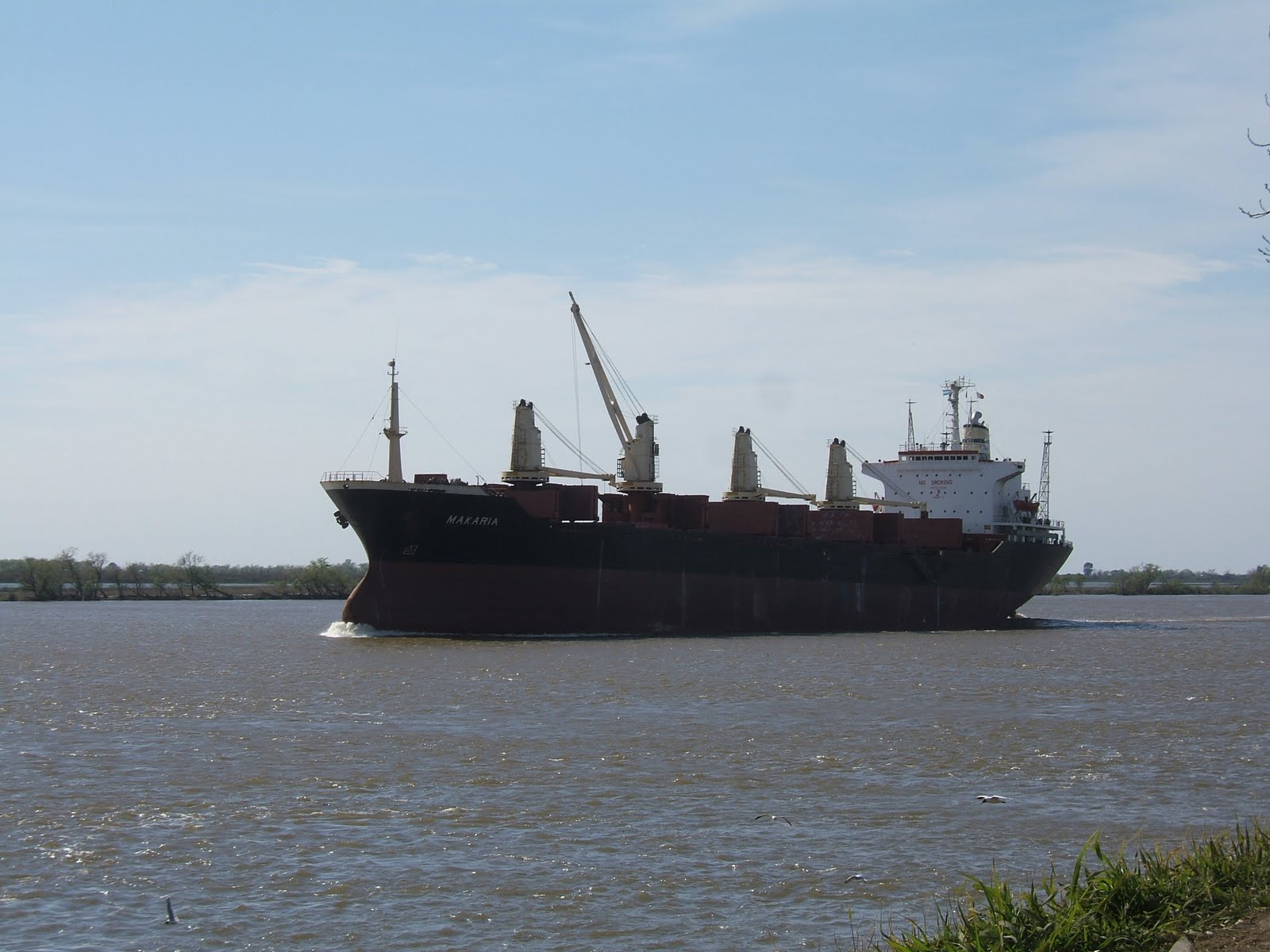
Rosario is a river city, with the Paraná, running roughly north to south, marking the eastern border. I walked to the shore yesterday and again today, noting the "No Fishing" signs next to the numerous fishermen (I don't know what they were hoping to catch) and watching a couple of ships pass. The water is brown; the current looks fast. I met a professor the other night who's training to swim across the river--it's an annual event. From the riverbank, it's a daunting proposition. I'll stick to running for now.


The contemporary art museum occupies a reconditioned grain silo. The driver of the paint truck parked beside it was likely just having a late breakfast at the museum café, but the truck seemed well-placed all the same.


All the benches on Blvd. Oroño are held up by paired sphinx. They look recently painted, for the most part, well-tended. I'm trying to imagine the civic boosters meeting where such a design plan was proposed and endorsed. Many of the benches seem to be work stations for the itinerant car-washers tending to the late-model vehicles parked nearby. No riddles, just small change.

Orientation can be a series of rules and expectations and procedures, neatly outlined and carefully explained. It's is also a spatial concept, one that implies attention to both context and perspective: what we see and from what vantage point. Sometimes there's not a lot to see. Sometimes it's a matter of waiting for light to penetrate stone.


Wednesday, August 17, 2011

Travel guides new and old


I love reading travel guides. I've bought several in preparation for my upcoming trip to Argentina, and I've pretty well cleaned out the public library's shelf. (Good news for those planning their own trips: I leave at the end of the month, and all books will be returned.) The university library has just one book specifically on Rosario, where I'll be teaching: a pamphlet titled Rosario: Argentina's Second City published by the Pan American Union in 1925. The emphasis is on commerce and modern development, with the occasional flight of fancy: "With ocean and river craft of all descriptions anchored for several miles along the water front, with sailors and river boatmen speaking varied languages, handling cargoes curious and interesting, a commercial picture is presented that merits the attention of a gifted painter." 
Most of the photographs, however, are of buildings--mostly banks, solid, blocky, and imposing. Certain details, though, do connect with my current translation project, such as a mention of the Jockey Club or a photo of palm trees on Blvd. Oroño. I've found mentions of the latter in travel books as well, and I'm looking forward to seeing the "real" haunts of the fictional characters whose adventures I've been rewriting into English.
I'll be teaching a course called Translating Argentina, using translation as a lens through which to consider cross-cultural experience and adaptation. We'll read some Borges, some Cortázar, some Gambaro. We'll read travel books and local advertisements. 
We'll all be translating ourselves, my students and I, rewriting ourselves into another language, another cultural context, introducing ourselves to new people, and then rewriting whatever adventures--or misadventures--we might have back into English, to tell our friends back home. Rethinking an experience in more than one language, I think, inserts a distance that encourages reflection--an opening, a necessary pause to think. The cheerful boosterism of the 1925 pamphlet reminds me, too, that whatever I might find in Argentina will be just one moment, open to reinterpretation over time as well.

Wednesday, February 23, 2011

Time and Place: Past/Present/Spring/Fall

I'll be teaching in Rosario in the fall. I always say "fall" when I announce this plan, though it will be spring in Argentina. It is almost impossible for me to think of October as anything other than autumn--I can imagine the month with different weather than that of Oregon or Michigan, but it's hard to affix a different label. This may be one more tell-tale sign of a person who, as my children like to remind me, never managed to leave school. Deformación profesional. For a translator-traveler, it doesn't bode well.

One of the stray details I recall from high school geometry is the idea of translation across a line. In September, I will "translate" myself across the Equator. Translate myself from the fall to the spring quadrant, plotting coordinates that in all likelihood are not functionally equivalent.

I've done this before. But in highland Ecuador, more on the Equator than across it, the seasons weren't marked, or the weather seemed spring-like when I expected spring, or persistent drought threw everything out of whack, so none of us--locals or visitors--knew what to expect.

In preparation for a spatial translation, I'm reading as much as I can. On the page--across the page--I translate just fine, to alternate realities, different worlds, parallel universes, an unbecoming future or a still imperfect past. Right now, I'm mid-way through Angélica Gorodischer's Trafalgar. (To my knowledge, the full collection hasn't been translated, though the first story, "A la luz de la casta luna electrónica"--"By the Light of the Chaste Electronic Moon"--appears in Fares and Hermann's anthology, Contemporary Argentinean Women Writers (1998), translated by Linda Britt.)

The book takes place, sort of, in Rosario. It is told in Rosario, as the inter-galactic salesman Trafalgar Medrano relates his travels and adventures to an unnamed listener/narrator (a woman who keeps cats and brews bad coffee). Questions of translation permeate the narrative, not only as demanded by encounters with the inhabitants of other worlds, but as a preoccupation or labor of the people (beings?) Trafalgar encounters, such as the linguist Veri Halabi in "La sensatez del círculo."

My current favorite, though, is "De navegantes." In this tale, Trafalgar visits the court of Isabel of Castilla in 1492--traveling not in time, but to a world that is nearly identical to the one he and his interlocutor inhabit some 500 years later. In either world, it's a pivotal moment in Spanish and world history. It's the seed of origin myths (the canon of Latin American literature often starts with Colón) and counter-discourses, dominion and resistance. Everything Trafalgar describes is familiar, except that it's not.

Trafalgar changes history, shifting the parameters of the conquest, though he isn't able to stick around and see how things turn out. The ethical clichés of time-travel fiction--the caution against meddling with events that seem all but foreordained, because of what we "know" comes later--are turned upside down.

No, turned sideways. Translated across a different axis. This is a parallel world, remember, just a degree or two off plumb. The seasons may be different, or they may be other seasons, seasons that only look the same from a distance.

It's a story I will keep thinking about.