Saturday, September 10, 2011

Paraná River Cruise

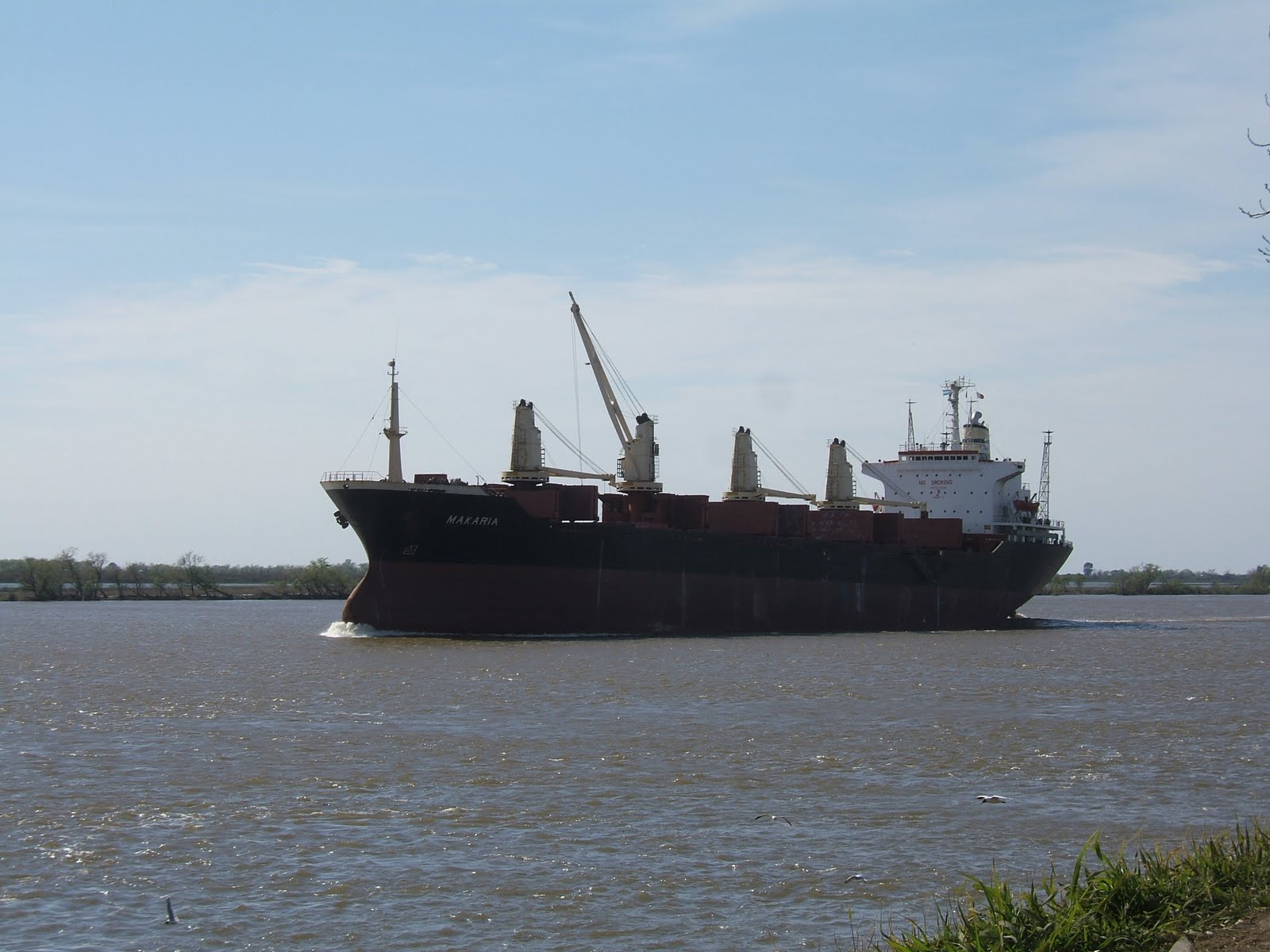
A few pictures from last weekend's river cruise, a two-hour trip from the Estación Fluvial (just below the Monumento a la Bandera), up to the foot of the Rosario-Victoria bridge and back. The water was high, so the boat was able to take a further channel, between islands, then return via the main channel of the Paraná.

Kayaks beached for a picnic

Long-term moorage
Fisherman's home


Some islands are more water than isle

Enough solid ground for a few cattle

And beehives (hard to see in the picture) behind a sign offering Miel

The Rosario-Victoria bridge, turn-around point for our boat


River traffic (heavy)

River traffic (light)

Approaching the dock again, near Parque España

Monday, September 5, 2011

Signs (taken for wonders?)

The exotic is always alluring; borrow a few words from another language, or a cinema icon from another era, and the possibilities blossom. Or wilt. I always enjoy reading signs (we recently turned the car around to photograph a sign for "Salad Shrimp" offered right next to night crawlers; imagine our disappointment when it was in fact "Sand Shrimp" that we had misread--a perfectly coherent listing of bait species.) A few signs that have made me smile, or left me thinking, over the past few days in Rosario:


Ming Fat Food? Is that really what they mean? (Lady Stork, at the bottom, sounds like maternity wear to me, but from the window, I think it's just regular shoes and clothes.) Eat too much Ming Fat, and you won't be able to achieve the long, lean lines demanded by:
Sutilezas King Kong--Alta Costura
Maybe it's the idea of King Kong's signature subtleties, heretofore unknown? High fashion in the sense of altitude, not class? The model looks as tall as the Empire State Building, anyway. 

For those of us in the more modest price ranges (far from high fashion) there's always:
Where everything's 2 pesos, unless it's not
The local variant on the dollar store promises everything for 2 pesos (about $0.50 US, right now) or "for less and more" as well. No one will be disappointed.

And finally, some of you have seen this, but I can't resist including Don Beef's promise to the masses: Pork for Everyone!


Seen any good signs lately?

Friday, September 2, 2011

Orientation: Stone Windows


alabaster window
It's orientation week, for students and visiting faculty alike. I want to say disorientation as well (notice my self-restraint--no parenthesis around the prefix, though both training and inclination leave me tempted to ask a word to be its opposite even as it is defined, greedily hoping to hold ambivalence and precision in the same little bundle of sound). But orientation, whenever someone takes the trouble to offer it, inevitably seems disorienting as well.


Recoleta Cemetery (from the--open--stone window)
Librería Ateneo Gran Splendid (Buenos Aires)
Before catching the bus to Rosario, I spent a couple of days beginning to find my way around Buenos Aires. At the Claustros del Pilar, an old section of the church beside the Recoleta Cemetery, I especially admired the stone windows, thin, translucent sheets of alabaster. There is something about the idea of a stone window that intrigues me (though I suppose glass, with its origins in sand, is only a more refined stone). Maybe it has to do with direction and enclosure: these windows are translucent, not transparent; they let light in, but you can't see out. 

I attended the theater-- the theater of live performance, and the theater of books. 

Rosario
I'm living in an eleventh-floor apartment downtown--not what I'm used to at all. My Buenos Aires hotel room, with its sought-after view of the air shaft, was much quieter. But I like the view from the enclosed balcony, and the cafés up and down the street, and the elevator with its complicated, manually-operated double doors.


Río Paraná
Rosario is a river city, with the Paraná, running roughly north to south, marking the eastern border. I walked to the shore yesterday and again today, noting the "No Fishing" signs next to the numerous fishermen (I don't know what they were hoping to catch) and watching a couple of ships pass. The water is brown; the current looks fast. I met a professor the other night who's training to swim across the river--it's an annual event. From the riverbank, it's a daunting proposition. I'll stick to running for now.


The contemporary art museum occupies a reconditioned grain silo. The driver of the paint truck parked beside it was likely just having a late breakfast at the museum café, but the truck seemed well-placed all the same.


All the benches on Blvd. Oroño are held up by paired sphinx. They look recently painted, for the most part, well-tended. I'm trying to imagine the civic boosters meeting where such a design plan was proposed and endorsed. Many of the benches seem to be work stations for the itinerant car-washers tending to the late-model vehicles parked nearby. No riddles, just small change.

Orientation can be a series of rules and expectations and procedures, neatly outlined and carefully explained. It's is also a spatial concept, one that implies attention to both context and perspective: what we see and from what vantage point. Sometimes there's not a lot to see. Sometimes it's a matter of waiting for light to penetrate stone.


Wednesday, August 17, 2011

Travel guides new and old


I love reading travel guides. I've bought several in preparation for my upcoming trip to Argentina, and I've pretty well cleaned out the public library's shelf. (Good news for those planning their own trips: I leave at the end of the month, and all books will be returned.) The university library has just one book specifically on Rosario, where I'll be teaching: a pamphlet titled Rosario: Argentina's Second City published by the Pan American Union in 1925. The emphasis is on commerce and modern development, with the occasional flight of fancy: "With ocean and river craft of all descriptions anchored for several miles along the water front, with sailors and river boatmen speaking varied languages, handling cargoes curious and interesting, a commercial picture is presented that merits the attention of a gifted painter." 
Most of the photographs, however, are of buildings--mostly banks, solid, blocky, and imposing. Certain details, though, do connect with my current translation project, such as a mention of the Jockey Club or a photo of palm trees on Blvd. Oroño. I've found mentions of the latter in travel books as well, and I'm looking forward to seeing the "real" haunts of the fictional characters whose adventures I've been rewriting into English.
I'll be teaching a course called Translating Argentina, using translation as a lens through which to consider cross-cultural experience and adaptation. We'll read some Borges, some Cortázar, some Gambaro. We'll read travel books and local advertisements. 
We'll all be translating ourselves, my students and I, rewriting ourselves into another language, another cultural context, introducing ourselves to new people, and then rewriting whatever adventures--or misadventures--we might have back into English, to tell our friends back home. Rethinking an experience in more than one language, I think, inserts a distance that encourages reflection--an opening, a necessary pause to think. The cheerful boosterism of the 1925 pamphlet reminds me, too, that whatever I might find in Argentina will be just one moment, open to reinterpretation over time as well.

Wednesday, July 27, 2011

Bored as an oyster?

Razor clam, boredom long past

The translation I'm working on includes the phrase, aburrirse como pingüinos-- become bored as penguins? A little sleuthing around turned up the phrase, aburrirse como una ostra or una almeja-- bored as an oyster, or bored as a clam. Bivalves likely lead pretty dull lives (though a razor clam can burrow down 24 inches in less than a minute which, allowing for scale, is faster than many bipeds can travel). A new phrase for me, but evidently a perfectly common way of saying "bored to tears" or "bored to death." Bored silly, bored stiff, bored beyond belief, bored out of one's mind--there's quite a variety of ways to say it in English. My guess would be lots of bored people, looking for colorful ways to complain. Based on the lists I've assembled so far, Spanish seems to have more "bored as an [x]" comparisons, while English speakers seem more likely to be bored into or out of a state or condition.

Idioms are a challenge--to teach, to translate, let alone to employ with any grace in one's own speech. One of my favorite moments from my college Spanish classes was when the exasperated professor, faced with a student's protest--"I'd never say it like that!"--responded drily, "Fortunately, the language is not limited to what you would or would not say." I think we were talking about heartbreak.

But about those penguins. In context, it's a variation on a common theme; the reader of the original would have the standard idiom in her repertoire, and notice the shift. Recognizable yet unexpected. I haven't quite worked out how to preserve that wrinkle in the English, though I'm thinking I might keep the penguins, just for fun. 


I'm seldom bored, but I'll be looking for ways to work the oyster's ennui into conversation.

Thursday, July 21, 2011

Cookbooks--a translator's best friend

Maybe I just tend to translate books full of food, even elaborate meals (the Virgin's Jubilee breakfast in La Virgen Pipona/The Potbellied Virgin being a favorite example) but I have found, mostly by chance, that international cookbooks provide a wealth of information for the translator. Plenty of ingredients--herbs, spices, cuts of meat--have straightforward parallels across languages, but many do not. Prepared dishes can be harder to indentify, and a lush, full-color illustration of the finished stew or conserve can be invaluable. Pictures can be especially helpful in a monolingual, source-language cookbook-- so that's what they're eating! Then there are the multi-lingual glossaries, the explanations of staples and procedures that might be daunting to a cook unfamiliar with the cuisine described. 

Not to be overlooked: the tangential fun of reading cookbooks. So many wonderful dishes to imagine without all the tedious chopping. One of my favorites carries a blurb that proclaims it a MUST for the bookshelf of any serious cook. I'm not really a serious cook. Grim, maybe, heating bean and cheese tortillas at a gallop before fencing classes or recorder lessons. But I like to dabble. Imaginary cooking requires little skill and only modest self-control to keep the snacking demons in check. And if I finally identify an elusive pastry, it even counts as work, not woolgathering.

I suppose it's a matter of seeing "dictionary" in the broadest possible sense--the plant books I've mentioned before, compendia of mythological creatures and little-known saints, forgotten movie reviews. Today's library trip had a specific goal: cookbooks from or about Argentina. There weren't too many in my local library but there were, I hope, just enough to get the characters through their breakfasts and on with the story. Maybe I'll even try cooking a new dish or two in preparation.

Monday, July 18, 2011

Argentina Count-Down (part 1)

I picked up a 6-week, inter-library loan on campus the other day, and the return date was none other than my departure date for Argentina. Aack! I've got as many to-do lists as a woman could wish for, but checking things off the lists is proving harder. So the packing/planning/copying/reserving/panicking begins in earnest. I spent half the morning today in front of the department photocopier, putting together a course packet that I could then scan and email to myself. But the scan was too big and the email never arrived, so I'll have to scan it again, part I and part II. I spent yesterday evening poring over guidebooks and web sites looking for weather information, needing to answer that all-important question: what should we pack? With different parts of the family heading in different directions at different times this fall, we're counting suitcases and wondering what can be borrowed, what must be bought. I'm a big believer in taking far less clothing and way more money than you think you'll need on any given trip; I have almost never wished I had more stuff to cart around. Still, we hate to be caught short, without the crucial book/tool/sweater that would make everything run smoothly.

It's also important to leave some room in the luggage for the trip home. Souvenirs, presents, paraphernalia-- call it what you will (I like the terms "research materials" and "realia for teaching purposes," both of which sound more purposeful than the "ephemera" we used to sell at the used bookstore where I worked in college). I'm already daydreaming about book shopping in Buenos Aires and Rosario. When we returned from our year in Ecuador in 1980, my parents would station one kid at each pile of luggage, then ferry suitcases and bundles from one to the next. That trip, we were bringing home gorgeous hand-tinted photographs, a huge wheel of cheese, copious research notes, the usual clothes and books, and two blow-guns. 

Easy to take along: virtual reading material in the form of links to favorite blogs. I've added a list of a few I enjoy reading, with more to follow. Do have a look if you haven't read them yet and, in a comment, take a moment to mention your own favorites that I might have missed.